Continued from Part I: From an article in the Omaha World Herald. Published May 8, 2005: “South 24th Street was dying. Where elbow-to-elbow throngs once bustled through department stores, furniture showrooms, shoe shops, bakeries and bars, more than half the storefronts along 24th Street from L to Q Streets were vacant by the mid-1980s.” https://www.omaha.com/townnews/commerce/th-street-gets-back-up-on-its-fee t/article_1aadefd2-8a85-11e6-81ac-fff9046507f6.html
This image (below) was taken by me on 27th of September, 2019. This building sits across the street from my art studio in Amesbury, Massachusetts. It reminds me of the building in the previous image of my father at 24th and Q Street in downtown Omaha, Nebraska - his picture taken in 1970.
The picture I took however, is the site of what was historically an industrious carriage factory located in what is named Carriage Hill, Amesbury, Massachusetts. A place where most of the world's finest horse-drawn carriages were manufactured in the mid-1800's . After the advent of the automobile these factories would boast a shift, becoming a central meeting point for creation of the market of crafting automobiles, producing some of the world's first and classiest auto bodies including one of the first electric vehicles made here in the United States. After Ford moved his factory-production facilities to Detroit, these buildings next became known as hat factories, making felt hats for buyers of fashion all over the world.
Now boarded up and in state of disrepair, the future of this building in uncertain, much like many neighborhoods both in nearby towns and across the country, their many-layered brick walls show a broken facade of a busy working class culture.
This image (below) was taken by me on 27th of September, 2019. This building sits across the street from my art studio in Amesbury, Massachusetts. It reminds me of the building in the previous image of my father at 24th and Q Street in downtown Omaha, Nebraska - his picture taken in 1970.
The picture I took however, is the site of what was historically an industrious carriage factory located in what is named Carriage Hill, Amesbury, Massachusetts. A place where most of the world's finest horse-drawn carriages were manufactured in the mid-1800's . After the advent of the automobile these factories would boast a shift, becoming a central meeting point for creation of the market of crafting automobiles, producing some of the world's first and classiest auto bodies including one of the first electric vehicles made here in the United States. After Ford moved his factory-production facilities to Detroit, these buildings next became known as hat factories, making felt hats for buyers of fashion all over the world.
Now boarded up and in state of disrepair, the future of this building in uncertain, much like many neighborhoods both in nearby towns and across the country, their many-layered brick walls show a broken facade of a busy working class culture.

22 h 19 min (1,464.1 mi)
Our household held onto story like myth. Laughing at rightwing policies and standing on the 'right' side of injustice, enjoying homemade wines, grown in organic gardens out back near the largess of the barn that was inherited as part of our family's home at 822 North 72nd Street in mid-town Omaha, Nebraska. This area was to the West of the Dundee district and North of the famous Ak-Sar-Ben racetrack (Nebraska spelled backwards).
Dad took the city bus to his work in downtown Omaha, on Farnam Street. That was when I was a young child, he was accustomed to leaving early in the morning and we would greet him with excitement after he returned from work as he always had a package of Trident gum in his pocket and would share smiles and a piece of gum! Mom would typically have made a meal for the large family - 6 kids - and we would sit most evenings as a family around our formica dining table in the small kitchen sharing stories of our days. It was festive most often than not.
As I approached middle school age, Dad was often driving me to school during which I would succomb to his mini-lectures - run-on sentences which I pretended not to be listening to. Early morning drives to school were filled with this overemphasis on my resolutely listening/not-listening to his citing the importance of chem trails or very dense discussions of material he had just read in classics such as with writings by American author, historian, actor, and broadcaster, Louis 'Studs' Terkel. *[Terkel had received the Pulitzer Prize for General Non-Fiction in 1985 for The Good War - best remembered for his oral histories of common Americans.(Wikipedia)]; or the quiet endless listening to my father sing folk songs by labor union leader, Woody Guthrie, such as Hobo's Lullaby which were cast out mindlessly I thought by my dad, but as I was forced occupant of the vehicle I listened only in hopes of not having to walk to school in sub-zero Nebraska temperatures. But this did lead me to appreciate Hitchhiker;s Guide to the Galaxy narrative Vogon poetry:
“Vogon poetry is of course, the third worst in the universe.
The second worst is that of the Azgoths of Kria. During a recitation by their poet master Grunthos the Flatulent of his poem "Ode to a Small Lump of Green Putty I Found in My Armpit One Midsummer Morning" four of his audience died of internal haemorrhaging and the president of the Mid-Galactic Arts Nobbling Council survived by gnawing one of his own legs off. Grunthos was reported to have been "disappointed" by the poem's reception, and was about to embark on a reading of his 12-book epic entitled "My Favourite Bathtime Gurgles" when his own major intestine, in a desperate attempt to save humanity, leapt straight up through his neck and throttled his brain.
The very worst poetry of all perished along with its creator, Paul Neil Milne Johnstone of Redbridge, in the destruction of the planet Earth. Vogon poetry is mild by comparison.”
― The Hitchhiker's Guide to the Galaxy
(https://www.youtube.com/watch?v=IxPeIiU2kx4).
So while he spun on about songs and research he would orate about articles he was relentless in sharing with me, relating typically 1-way conversations regarding essays from Mother Earth News (started in 1970) https://www.motherearthnews.com/nature-and-environment/story-of-mother-earth-news-zmaz90mazshe; or Daedulus Journal https://www.mitpressjournals.org/loi/daed;
As Don Quixote tilted windmills ...
'Tilting at windmills' Tilting is jousting. The expression 'tilting at windmills' derives from Cervantes' Don Quixote - first published in 1604, under the title The Ingenious Knight of La Mancha. The novel recounts the exploits of would-be knight 'Don Quixote' and his loyal servant Sancho
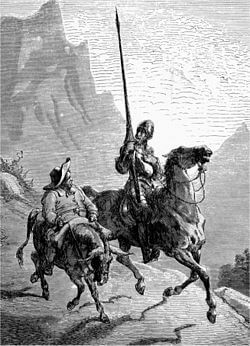
Panza who proposed to fight injustice through chivalry. It is considered one of the
Comments
Post a Comment